Pasta Boxes: Complete Guide to Custom Pasta Packaging
Introduction
Pasta boxes should do more than hold a food product. They should fit the pasta correctly, support practical handling, communicate useful product information, and give the brand a recognizable presentation.
For pasta manufacturers, artisan food businesses, restaurants, and specialty retailers, custom pasta boxes provide an opportunity to bring these requirements together. Packaging can be developed around long spaghetti, short pasta shapes, delicate nests, individually sealed products, or complete pasta gift collections.
However, pasta packaging is not a one-size-fits-all solution. A retail carton for dry penne has a different job from an outer sleeve for refrigerated ravioli or a takeaway container for a cooked pasta meal. The starting point should always be the product and its intended use—not simply the appearance of the box.
This guide explains how to approach custom pasta packaging, including box structures, materials, sizing, printed branding, windows, food-contact considerations, wholesale ordering, and sample testing.
What Are Pasta Boxes?
Pasta boxes are packaging structures designed to contain, present, or support the transportation of pasta products. Depending on the application, the box may hold the pasta directly or act as an outer package around a sealed pouch, tray, or other primary container.
That distinction matters when developing a packaging brief. The surface touching the food needs to be suitable for that particular application. FDA food-contact guidance, for example, distinguishes between dry foods, foods containing fats or oils, and different storage or heating conditions. A material appropriate for one application should not automatically be assumed suitable for another.
Before discussing artwork, identify whether the project concerns dry retail pasta, fresh packaged pasta, cooked takeaway meals, or gift packaging.
Types of Custom Pasta Boxes
Dry Pasta Retail Boxes
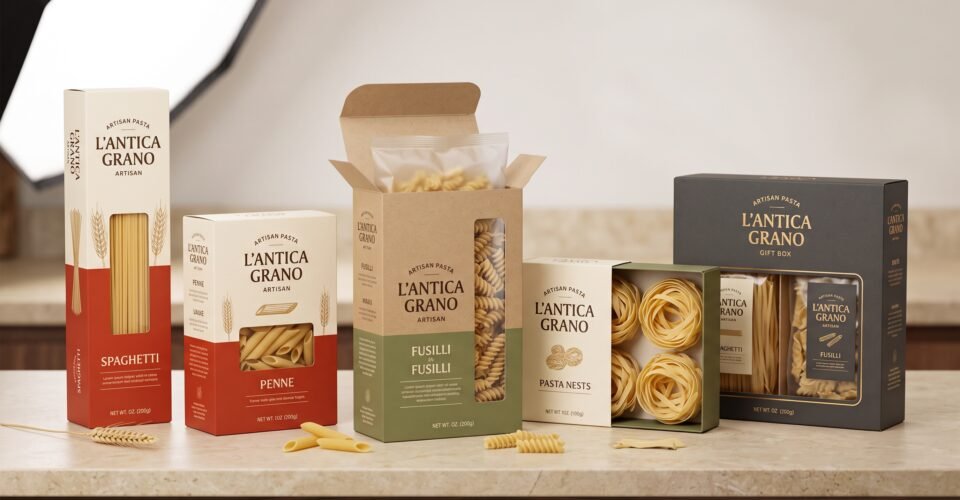
For dry pasta, start with a folding-carton concept shaped around the product. A long, narrow carton may suit spaghetti, while a shorter, wider structure may better accommodate penne, fusilli, or macaroni.
Folding cartons offer flexibility in dimensions, closing features, printing, and finishing. They are used across food packaging applications and can be developed around both product presentation and filling requirements.
For your own project, specify whether the pasta will be packed directly into the carton or enclosed in a separate inner pack.
Pasta Boxes With Windows
A window can make the pasta shape part of the packaging design. For example, a narrow vertical opening can display spaghetti strands, while a smaller front-panel window can show a selection of short pasta.
Treat the window as a structural feature rather than just decoration. Ask the packaging supplier to review its position, the remaining board around it, and how the window integrates with the complete food-contact system.
Fresh Pasta Outer Boxes and Sleeves
For fresh pasta, develop the printed box or sleeve around the primary food package.
Where the product requires refrigerated storage, specify that condition during packaging development. The outer carton should complement the sealed container and its intended storage system rather than replace it. Refrigerated storage is a distinct condition in FDA food-contact guidance.
A useful design approach is to keep the product name, storage instructions, and date-code area visible without requiring customers to remove the sleeve.
Pasta Takeaway Boxes
Cooked pasta packaging needs a separate development brief from dry-pasta cartons.
For a sauced meal, ask the supplier to evaluate the actual filling temperature, sauce composition, portion weight, closure, and expected delivery duration. Test the finished container with the real menu item rather than assuming that a printed paper box will handle every recipe.
Plan the opening so customers can access the meal comfortably without struggling with oversized flaps or a narrow rim.
Pasta Gift Boxes
Pasta gift packaging can bring together several individually packaged products, such as two pasta varieties and a sauce jar.
Design the interior arrangement before choosing the outer dimensions. Give heavier items their own support, and avoid placing a glass jar where it can press against delicate pasta shapes.
For a premium presentation, consider a lift-off lid or sleeve-and-tray design, with branding concentrated on the lid and a recipe card inside.
Choosing Materials for Pasta Packaging
Folding Carton Paperboard
Paperboard is a starting point for printed retail cartons. During development, compare the proposed board with the product weight, carton dimensions, filling process, and desired finish.
Do not specify the material using appearance alone. Request a physical sample so you can assess panel stiffness, fold quality, opening behavior, and how the box feels when filled.
Kraft-Style Packaging
A kraft-brown exterior can support an understated, artisan visual identity. Pair it with restrained typography and a small number of print colors when that matches your brand.
However, a brown surface is not proof of food-contact suitability, recycled content, or recyclability. Treat visual appearance and material performance as separate decisions, and request documentation for any functional or environmental claims.
Corrugated Outer Packaging
For shipping projects, consider a separate outer package rather than expecting the retail carton to perform every role.
Develop the outer dimensions around the number of retail units, their arrangement, and any required cushioning. Test the assembled package—not just an empty shipping box.
Rigid Board for Gift Presentation
Consider rigid construction when the project is a premium gift set rather than an everyday pasta carton.
Evaluate the extra material, assembly, storage space, and shipping volume against the presentation you want to achieve. A simpler folding gift box may be a more practical choice for some collections.
Food-Contact Suitability and Product Protection
“Food-grade cardboard” should not be the entire specification.
Ask the supplier to confirm the suitability of the finished packaging system, including relevant board, coatings, inks, adhesives, windows, and liners. The intended food type and conditions of use should be part of that discussion. FDA maintains guidance and inventories covering food-contact substances and their uses.
For dry pasta, moisture management also deserves attention. Barilla advises storing its dry boxed pasta in a cool, moisture-free location. That illustrates why a dry-pasta packaging brief should consider storage conditions alongside appearance and handling.
Do not describe a carton as airtight or claim that it extends shelf life unless the complete product-and-package system supports that statement. An attractive exterior alone does not establish preservation performance.
How to Choose the Right Pasta Box Size
Begin with a filled-product trial, not a guessed external dimension.
A pack weight such as 500 grams does not establish the required box size by itself. Long strands, hollow tubes, spirals, and pasta nests occupy space differently. An inner pouch can also change the final dimensions.
For a sizing trial, measure the product in its intended arrangement, including any pouch, tray, or divider. Then assess the space needed for filling and closing without crushing the contents.
For long pasta, check clearance at both ends. For short shapes, assess how the contents settle during handling. For nests, test the arrangement carefully so closing the lid does not press down on the product.
Ask the supplier to distinguish internal usable dimensions from external box dimensions in the quotation.
A useful packaging brief might read:
Develop a printed retail carton for a 500-gram penne product, packed inside a sealed pouch. Confirm the final internal dimensions using a filled sample before approving the cutting layout.
This communicates the application without presenting an untested dimension as a production specification.
Custom Printed Pasta Boxes and Branding
Use the front panel to answer the customer’s most immediate questions: What is the product, which variety is it, and which brand makes it?
Build the rest of the artwork around that hierarchy. A pasta collection could use consistent logo placement and typography, with different accent colors for each shape or recipe.
For example, a proposed design system might use olive green for fusilli, deep red for penne, and warm cream for spaghetti. These are design choices, not substitutes for clear product names.
Reserve secondary panels for cooking guidance, product details, and brand storytelling. Keep important text away from folds, window edges, and glue areas.
For a premium outer gift box, a restrained embossed mark or small foil accent may suit the concept. Confirm the manufacturing feasibility and intended use before adding decorative finishes.
What Information Should Appear on Pasta Packaging?
Allocate space for product information before finalizing the decorative artwork.
For packaged retail food, the labeling plan may need to address the product name, net quantity, ingredients, nutrition information, and business details. FDA’s Food Labeling Guide covers these topics for relevant U.S. products; requirements should be checked for the actual market and product before printing.
Allergen information also needs careful review. Wheat, eggs, or other allergens may be relevant depending on the recipe. For FDA-regulated packaged foods, major allergens used as ingredients must be identified appropriately; the artwork should follow the actual formulation rather than a generic pasta template.
From a design perspective, reserve practical areas for the barcode, batch or date coding, storage instructions, and cooking directions. Check these areas on a full-size printed proof, not only on a screen.
Pasta Packaging for Takeaway and Delivery
For restaurant applications, test packaging with the complete meal under realistic service conditions.
Use the intended portion, sauce, garnish, and filling temperature. Close the container, place it in the normal delivery arrangement, and examine it after the expected journey. Check for staining, leakage, softened panels, closure problems, and whether the meal remains easy to access.
Do not add a microwave-safe claim simply because the container is paper-based. FDA guidance advises using containers specifically intended for microwave use and following the relevant instructions. Decorative finishes and other components also need consideration before reheating instructions are printed.
A takeaway design should be developed for its food-service job, rather than adapted from a dry-pasta retail box based only on branding.
Pasta Boxes for E-Commerce
An online order introduces a different packaging journey from a product handed directly to a customer.
Define how many retail cartons will be shipped together and whether the order contains additional products. A pasta-only order and a pasta-and-sauce gift set should not automatically use the same internal arrangement.
For sample testing, inspect the products after handling—not just the outside of the parcel. Look for broken pasta, crushed corners, loosened closures, and movement between items.
Keep the retail presentation and shipping protection as separate requirements in your brief. This makes it easier to identify which component needs changing when a test reveals a problem.
More Sustainable Pasta Packaging Choices
Start sustainability discussions with specific design decisions: appropriately sized boxes, unnecessary components that could be removed, and documented material choices.
Avoid assuming that kraft, paper-based, or window packaging is automatically “eco-friendly.” Under the FTC’s U.S. Green Guides, broad environmental claims need substantiation, recyclable claims may require qualifications based on available facilities, and compostability claims require suitable evidence.
Ask about the complete package, including coatings, window film, liners, and inserts. Where accurate and supported, a specific statement about a component or verified material attribute is more useful than a vague environmental promise.
Wholesale Pasta Boxes and Cost Planning
Request quotations using the same specifications so the options can be compared meaningfully.
Include the proposed structure, dimensions, product weight, material requirements, artwork versions, window design, packing method, and order quantities. Ask suppliers to identify any separate charges for tooling, printing setup, samples, packing, and delivery.
For a range containing several pasta varieties, compare the cost of separate artwork versions with a shared design that uses a defined variable-label area. Evaluate the appearance and operational tradeoffs rather than assuming one approach will always be cheaper.
There is no universal minimum order quantity or unit price for custom pasta boxes. Obtain project-specific figures and confirm what each quotation includes.
What to Check Before Approving Production
Approve the structure and artwork through different checks.
First, use a physical structural sample to assess product fit, filling, closing, opening, and handling. Include the actual inner pouch or tray where applicable.
Next, review the artwork on the agreed box layout. Check panel orientation, product names, variant information, readable text, barcode placement, coding space, and the position of any windows.
Finally, evaluate the most representative production sample available. A blank prototype can demonstrate fit, but it cannot confirm print color or the appearance of the final surface finish.
Before placing a large order, resolve the most important questions:
- Does the complete product fit and remain properly contained?
- Are the materials documented for the intended application?
- Are the artwork and product information approved?
- Has the relevant handling or delivery trial been completed?
Common Pasta Packaging Mistakes to Avoid
The first mistake is treating dry, fresh, and cooked pasta as the same packaging application. Give each format its own specification.
Another mistake is choosing dimensions from product weight alone. Test the actual pasta shape and inner packaging before approving size.
Avoid making the window the dominant design feature before checking the structure and labeling space. Similarly, do not add decorative finishes before confirming that they suit the packaging’s intended use.
Finally, avoid approving a large order from a digital mockup alone. The appearance of a box on a screen does not show how it fills, closes, carries, or performs with the product inside.
Frequently Asked Questions About Pasta Boxes
What are pasta boxes used for?
Pasta boxes can serve as retail cartons, outer packaging around sealed products, takeaway containers, or gift packaging. The appropriate design depends on the pasta format and intended use.
Can pasta boxes be customized with a logo?
Yes. Printed cartons can incorporate logos, product names, colors, illustrations, and other artwork. Confirm the available printing and finishing options with the supplier for the chosen structure.
How do I choose a box for 500 grams of pasta?
Use a filled sample of the actual pasta and any inner packaging. Do not choose the dimensions from weight alone; assess the product’s arrangement, usable internal space, and closure clearance.
Can dry pasta go directly inside a cardboard box?
The answer depends on the finished packaging and its suitability for direct contact with that food. Confirm the applicable materials and conditions of use with the supplier rather than assuming all cardboard is suitable.
Are pasta takeaway boxes microwave-safe?
Not automatically. Use packaging specifically intended for microwave use and follow its instructions. Do not infer microwave suitability from a paper-based appearance.
Can custom pasta boxes include windows?
A window can be incorporated into a proposed design, subject to structural and material review. Ask the supplier to show how the window affects the complete package before approval.
Can small pasta brands order custom packaging?
Small brands can request project-specific packaging quotations. Ask about minimum quantities, sample options, artwork versions, and available structures rather than assuming every supplier has the same requirements.
Are kraft pasta boxes recyclable?
A kraft appearance alone does not establish recyclability. Assess the finished package and the recycling facilities available where it will be sold, and qualify any claim appropriately.
Final Thoughts
The best pasta boxes begin with a clear understanding of the product. Dry spaghetti, short pasta, fresh packaged ravioli, and cooked takeaway meals each call for a different packaging brief.
With custom pasta boxes, brands can develop the structure, size, printed design, and opening experience around those requirements. The strongest result combines a practical package with clear information and recognizable branding—not decoration alone.
Discuss Your Custom Pasta Packaging Project
Planning new pasta packaging? Share your pasta format, target pack weight, inner packaging, estimated quantity, and artwork requirements with FormatPacking to discuss the project.